Private Fusion to Drive UK Growth
The UK Government issued its 2026 fusion energy strategy, with the focus squarely on industrial growth.
UK-based inertial fusion energy company First Light Fusion has warned that the UK risks falling behind the US and China in the race for fusion without a shift in approach.
On July 17, the UK Government published its response to the consultation on National Policy Statement (NPS) EN-8, which was launched in May 2024 to streamline the process and provide clarity on the planning of fusion power plants. In its response, the Government focuses on enabling the delivery of fusion power plants, highlighting near-term economic opportunity and explicitly recognizing that private companies plan to deliver commercial fusion plants within the 2030s.
The UK Government’s designation of fusion energy as a key focus in its newly released Industrial Strategy is important. The prioritization of fusion as a “Clean Energy Industry” by the Department for Energy Security and Net Zero (DESNZ) – on top of its recent £2.5 billion commitment – demonstrates the UK’s serious intent to lead the global race to rapidly bring fusion to market.
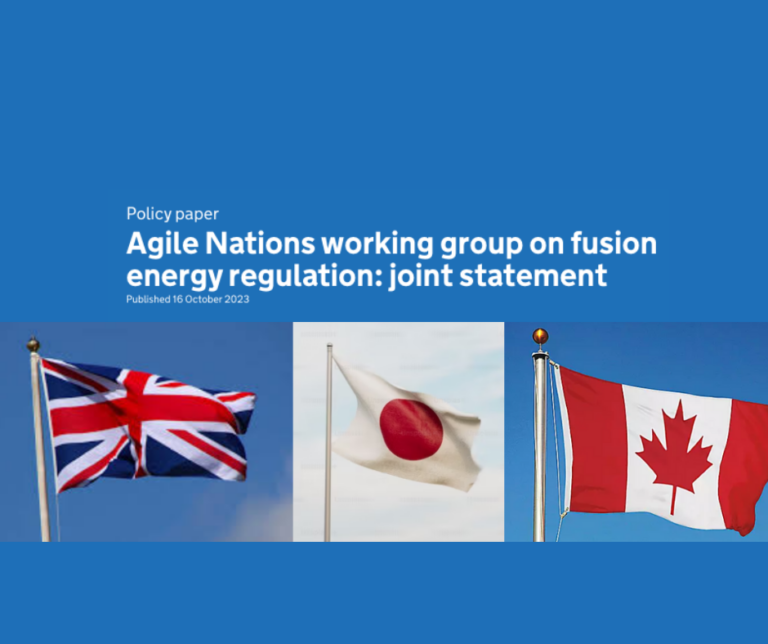
Japan and the UK will collaborate on fusion to achieve viable demonstration by the 2030s, combining the UK’s remote-controlled robot technology with Japan’s manufacturing capabilities.
FIA welcomes British Government’s long term commitment to transformational clean energy.
With a world-leading fusion research ecosystem, the UK is poised to be a global leader in commercial fusion – but must act now to attract the quickly growing industry as companies look to site first plants.
The UK government needs to act now to attract companies in order to take the lead in the global fusion industry, according to Fusion Industry Association policy report.
UK can lead £31 trillion Global Fusion Industry, but government needs to act now to attract fusion companies, says Fusion Industry Association.
Chancellor of the Exchequer Rachel Reeves announced the United Kingdom’s Autumn Budget 2024 on October 30, outlining key provisions and missions for “Rebuilding Britain” and areas of targeted government support going forward. The budget notes a heavy emphasis on greater support for “Innovation,” including fusion energy.
Magnetic confinement: Plasma is heated to 100 million °C or more, then squeezed and held in place by strong magnetic fields, allowing many fusion reactions to occur. (Example: tokamaks, stellarators)
Inertial confinement: Tiny fuel pellets are struck by powerful lasers. The outer layer explodes outward, compressing the core to fusion conditions for a few nanoseconds, producing a brief but intense pulse of energy from each pellet. (Example: National Ignition Facility)
Hybrid systems: Combine compression (e.g., from lasers, plasma pistons, or mechanical impact) with moderate magnetic fields to reduce energy losses and improve confinement.
Electrostatic fusion: Uses high electric potentials to accelerate ions toward a central reaction zone, causing them to collide at high energies and fuse. The ions are guided and confined by electric fields rather than magnets, creating a compact environment for fusion reactions.